International Yoga Day

iyd

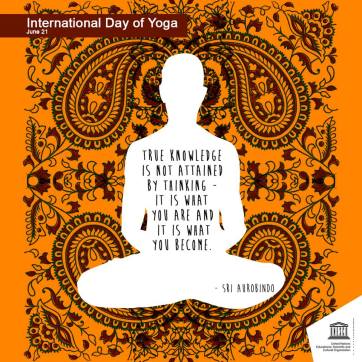
On December 11th, 2014, the UN General Assembly declared June 21st to be the International Day of Yoga. The declaration was a result of a call by India’s Prime Minister, Narendra Modi to make June 21st the International Day of Yoga. To the Assembly, Mr. Modi stated: “Yoga is an invaluable gift of India’s ancient tradition . It embodies unity of mind and body; thought and action; restraint and fulfillment; harmony between man and nature; a holistic approach to health and well-being. It is not about exercise but to discover the sense of oneness with yourself, the world and the nature. ”

June 21st, 2015 was the first official International Day of Yoga. Over 175 nations supported and sponsored the event. Celebrations included large scale community classes made available throughout many countries including the U.S., India, and Kenya. Making yoga available to the masses is one of the main goals of International Yoga Day. While many countries embrace yoga, access can be an issue. By providing free community classes, this day allows everyone to experience the magic of yoga. In 2016, the celebrations continued. Yoga studios around the world offered free classes the entire day as well as large scale community classes.

Let us hope this tradition continues to grow each year, allowing yoga to touch and heal the world around us. Embrace and celebrate the yogi within and remember to always respect where you are at. I look forward to celebrating each year and sharing yoga with everyone in my community.

iydofficial

Yoga for Back Pain

Chronic back pain is a common issue attended to by many physicians. While there are many medications available to manage pain, there are also very simple, low impact exercises that can reduce or even eliminate mild back pain all together.

Yoga is a great form of exercise that can ease pain and discomfort throughout the body. The great thing about yoga is that it allows one to focus on specific areas of the body if needed. There are many yoga poses that focus on stretching out the back muscles, thus potentially easing or eliminating back pain.

Here are some poses that can ease and reduce back pain (images from Google images):

Cat-cow

Start on your hands and knees with your spine neutral (think of your back as a table top). Use your breath to move between the two poses, breathing in during cow pose and out during cat pose. Move slowly and with intention.

Benefits of cat-cow:

  • Improves balance and coordination
  • Strengthens and stretches the spine and neck
  • Stretches the hips, abdomen and back
  • Massages and stimulates the kidneys and adrenal glands
  • Relieves stress and calms the mind

Downward facing dog

Press equally between your hands and feet. Press back, pulling your chest towards your thighs. Bend the knees and elbows to reduce pressure in the shoulders. Pull your heels towards the mat or floor (it is not required for your heels to touch the mat/floor).

Benefits of downward facing dog:

  • Calms the brain, relieves stress
  • Energizes the body
  • Stretches the shoulders, hamstrings, calves, arches, and hands
  • Strengthens the arms and legs

Half Pigeon (do pose on each side)

From downward facing dog take your right leg towards your arms and bring the leg down flat with your foot on the outer edge, facing the left hand. Square your hips and bend your right knee as much as is comfortable. Keep your torso up or fold it to the ground, being sure to listen to your body and making sure that your body isn’t feeling any pain. Repeat this pose with the left leg.

Benefits of half pigeon:

  • Stretches out hip rotators and flexors
  • Stretches out lower back and spine
  • Relieves tension

Standing forward fold

Stand with your feet together or slightly apart (about two fists distance), whichever feels more balanced. Gently fold from your hips, bending your knees as much as feels good. Take your hands to the floor or hold opposite elbows, using your arms to frame your head. Sway from side to side, slightly twisting at the waist. Settle into the forward fold, allowing gravity to pull your head and spine towards the ground. Stand in this pose as long as feels good. Roll your spine up slowly, one vertebrae at a time, coming into mountain pose (tadasana).

Benefits of forward fold:

  • Helps relieve stress
  • Stimulates the liver and kidneys
  • Stretches the hamstrings, calves, and hips
  • Strengthens the thighs and knees
  • Reduces anxiety

Supine twist (do pose on each side)

Lay flat on your back. Keep your left leg straight, take your right knee into your torso, and use your left arm to pull your knee to the left side. Take your right arm out to the right side, keeping your right shoulder blade to the floor, turning your head towards the right. You can take both knees bent together and twist them as well, whichever feels better for your lower back. Repeat this pose with the left leg.

Benefits of supine twist:

  • Helps release the lower back
  • Opens tight shoulders
  • Elongates spinal muscles
  • Calms the mind

Ease into each pose and create your own flow. Take time in each pose. Be sure to breathe deeply into each pose and if there is any pain adjust or come out of the pose.

Be sure to get professional medical advise before using these poses to treat any chronic or severe back pain.
Starting Your Yoga Practice

In today’s world of fifteen minute abs and diet pills, starting a healthy, physical exercise routine can be daunting. Between work, the kids’ soccer practice, dance recitals, and making dinner, who has the time to dedicate to a yoga practice. It’s hard enough to try and find time for a morning run, let a lone an hour to do yoga.

Well, first things first. You don’t need an hour! One can get the complete benefits of an hour long practice in a 15-20 minute time frame. The only caveat is one must be completely focused on their practice during that time.

The first thing you need to do when starting a yoga practice is learn to focus on the breath. By focusing on the breath, you will be able to be more present. As you move through each pose, allow your mind to wander as it naturally does in the moment, but bring it back to the breath. Focus on your breathing and you’ll find your mind will open and your body will start to relax. Try taking a few minutes out of your day and just focus on your breathing. Move from short breaths to longer, deeper breaths. See how that feels in your body, feel the changes in your muscles and joints. Really focus on how the change in breathing affects different parts of your body.

Another issue that always comes up is the poses. If you don’t feel like you’re a flexible person, yoga can be an intimidating activity. Trying to balance on your shoulders or your head can seem pretty impossible if you’re having a hard time simply sitting with your legs crossed. This is the vicious cycle that we fall into, we aren’t flexible so we don’t think we can even make an attempt at doing something that may help us become more flexible. The great thing about yoga is that there are poses and modifications for ALL LEVELS! If it’s your first class or if it is your 100th class, you CAN do yoga. If attempting to do your first downward facing dog hurts or feels uncomfortable, put your knees down. It’s okay! The goal of yoga isn’t to get into a specific pose, the goal is to create space, to release tension, and to open up your mind. Don’t judge yourself based on the person next to you in a yoga class, focus on yourself.

If going to a yoga studio is too intimidating, that’s okay too. There are so many great videos on YouTube or Yoga Social websites like DoYouYoga.com. They have series and single flow series. You can find pretty much any type of yoga routine you’re looking for, from the very basics to the most advanced!

So take a deep breath and dive in! You’ll never regret it!