The news headlines have been recently saturated with stories of yoga with different types of animals. So what are the benefits of doing yoga with animals?
Animals are often seen as companions. They can provide calm when we are stressed and provide comfort when we are lonely or sad. In a yoga class, animals can provide a sense of comfort and distraction. Many people feel overwhelmed or intimidated when in a yoga studio class. Looking around, it’s almost natural to compare ourselves to others in the class. With the addition of animals, one can be distracted from those feelings by focusing on the animals.
Distraction can also be a negative side-effect of doing yoga with animals. The main purpose of yoga is to bring yourself into the present moment, to focus on the sensations of the body and the feelings within. Having animals roaming around the studio (or farm) can take away from that “being present” mindset. It can also distract you from focusing on your breath or on specific poses in the asana practice.
Either way, yoga with animals in on the incline. Studios across the country are beginning to offer classes with “social” animals and the reviews are more positive than negative. Maybe yoga with animals helps increase awareness, as you are having to focus on your yoga practice and try not to be distracted by the cute, fluffy bunnies. Maybe it’ll help to focus on the sounds and smells of the farm while the goats are chewing on their grass. Ultimately, yoga is what YOU make it, so give yoga with animals a go! Who knows, it may be the purrrrrrfect practice for you.
Let’s be honest, kids can often drive us bonkers. They are little bundles of high energy which, when combined with lack of sleep, can lead to exhaustion and frustration.
Yoga is a great tool not only to help kids use that energy but also to help instill a sense of calm and focus. Many kids have trouble focusing or sitting still, which can lead to other issues later on. Yoga can teach children tools and techniques to help them focus and sit still not only at home but at school and in many other situations.
Here are just a few of the benefits yoga can have for children (and adults):
Yoga promotes non-competition.
Yoga promotes self-acceptance and awareness.
Yoga promotes empathy.
Yoga teaches techniques to focus and stay calm in difficult situations.
Yoga supports and promotes positive mental health and coping strategies.
So now that you’re convinced yoga is good for children, how do you teach them yoga? You don’t have to go through an entire 200 hour yoga teacher training. Though a short day or weekend training is recommended, here are some quick tips to teach basic yoga to children.
Keep the practice FUN!
Be high energy to promote high energy.
Do the poses with the kids.
If the kids are old enough, allow them to provide input on what poses they like.
Build your class for your kids at their level.
Keep the class fast paced.
Use games, be playful. Yoga doesn’t have to be serious.
Help the kids by adjusting them or assisting them.
One of the key things to remember is that kids will be kids. They will get distracted, they will want to stop. Just go with the flow and see how the practice progresses over time! After a few weeks/months, you may see a difference!
Now that the holidays are over, many of us are dealing with the reality of going back to work. Many of us struggle to continue feeling the relaxation and renewal we gained through a vacation or simply having time off. Even after a long weekend, so many of us curse that dreaded Monday alarm. This is often because of the stress we feel from our jobs. Every job has stress, whether you work at a computer all day or you work with people, stress is a factor. This stress often illicit physical and mental reactions, resulting in a negative association with our jobs or workplace.
Here are some yoga tips to help mitigate that workplace stress:
First, before doing any physical poses, when you feel stressed take a few deep breaths.
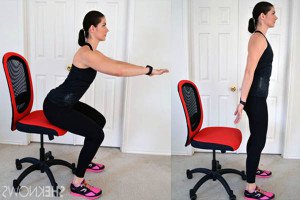
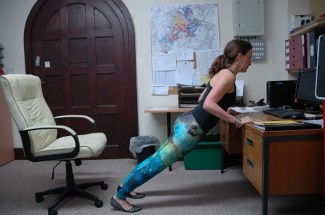
Then, continue on to do a few yoga poses at your desk to help reduce some of that work place stress. Here are some examples:
Seated Crescent Moon Pose
Chair Pigeon Pose
Sit and Stand Chair Pose
Desk Chaturanga (push-up)
Desk Downward/Upward Dog Pose
Seated Cat/Cow
Repeat each pose as desired, or as much as you have time for. Also remember to breathe throughout the pose. Hold each pose for 5-10 breaths to receive full benefits for stress reduction.
Hopefully these will help in transitioning back to reality.
When each year comes to an end, we see so many advertisements about dieting, starting the new year off right. We see stories about new year’s resolutions, how to keep them, and what goals to stay away from. We get advice about how to many achievable goals and what to do if we don’t meet the expectations we’ve set for ourselves.
Let’s face it, resolutions can be hard to keep. Even when we add goals with the best of intentions, often we find ourselves “failing”. Instead of being a wonderful new beginning, New Year’s can bring on stress and feelings of letting ourselves down. So many of our goals are either vague, like “I will eat better in 2017”, or we don’t take into account that a goal may not be achievable, like “I will go to the gym for an hour every day”. These two examples can set us up for failure. Why put that on ourselves?
Instead of trying to change our whole lives in one go, why don’t we take small steps towards that larger goal? Back in 2015, I added the resolution to do yoga each and every day that year. Sadly, I did not achieve that goal. I did, however, push myself to do more yoga than I had ever done. In 2016, instead of saying I would do yoga every day, I told myself I would do something good for me each day, whether it was eating a salad, meditating, or even doing yoga. While this is a vague concept, I think it helped me with the first step of embracing a yoga lifestyle, meaning I was becoming more present and aware in my life. By becoming more aware of how my body felt after a meal or what I was feeling in the morning, I was really attuned to what I wanted and what my body needed each and every moment of the day. From there, it was much easier for me to embrace yoga each and every day. In the mornings I soon observed that when I took time to meditate, I felt much better throughout the day. I also noticed that after just 15 minutes of yoga, I felt much more clarity and inner peace.
Ultimately, while I may not have done yoga every day this year, I am closer to reaching that goal. I have also successfully integrated meditation and pranayama (breathing practices) into my daily routine. This, combined with eating healthy based on my body’s needs and wants, has really illustrated that our goals are achievable. We just have to give ourselves a break and really start with creating self-awareness.
Cheers to 2017! Here’s to achieving greater awareness and being present.
The ancient practice of yoga is now listed as one of UNESCO’s “Intangible Cultural Heritage of Humanity”. In 2014, UNESCO’s committee for safeguarding listed practices voted unanimously for India’s proposal to add yoga. Yoga is now OFFICIALLY an international heritage and treasure…as if yogi’s really needed an official notice.
So what does this mean?
The main reason for creating the list is to highlight cultural contributions and heritages present around the world. By creating this list, UNESCO is essentially fostering understanding between cultures, highlighting the great contributions they have made to societies and cultural progress.
As quoted from the UNESCO website:
“Based on unifying the mind with the body and soul to allow for greater mental, spiritual and physical wellbeing, the values of yoga form a major part of the community’s ethos. Yoga consists of a series of poses, meditation, controlled breathing, word chanting and other techniques designed to help individuals build self-realization, ease any suffering they may be experiencing and allow for a state of liberation. It is practised by the young and old without discriminating against gender, class or religion and has also become popular in other parts of the world.”
Essentially, this list is a means to preserve cultural practices. UNESCO is not only highlighting yoga as a cultural contribution to the world, but it’s also creating a means to safeguard the practice from cultural elimination. Apparently, UNESCO may offer technical or financial support to communities who may be struggling to protect such ancient practices. This is still something to be seen happen or confirmed by UNESCO.
Ultimately, the addition to yoga to UNESCO’s list of cultural contributions helps us further the use of its traditions not only for physical exercise, but for overall health and healing. It also gives yogis an even better response when asked, why yoga?
For a complete 2016 additions to the list of UNESCO’s “Intangible Cultural Heritage of Humanity”, click here.
“Trauma-Informed” is another buzz word going around these days. What it means to be trauma-informed isn’t always clear though. How to become trauma-informed is even more unclear.
In the realm of yoga, being trauma-informed seems natural. Sadly, it’s not always the case. Often the things we, as yoga teachers, try to do to assist the practicing yogi may in fact cause the trauma to resurface and may even lead to re-traumatization. Something as simple as moving someone’s hand can be the difference between a very gentle stretch and an anxiety inducing movement.
Many organizations are offering trauma-informed yoga teacher trainings. While the full 200 hour teacher training may not be completely trauma informed, weekend workshops and classes often incorporate or emphasize techniques necessary to work with traumatized and vulnerable populations.
One such organization is Street Yoga. This organization, based in the state of Washington, provides trauma-informed yoga classes to at-risk youth. This organization also travels around the world to provide trauma-informed yoga teacher training workshops to allow for vulnerable populations to have access to yoga. Yoga can teach many coping skills, allowing traumatized individuals to cope and move through their trauma.
Some key examples to being a trauma-informed yoga teacher includes:
-Minimal physical adjustments
-Reducing the use of vulnerable poses (like child’s pose)
-Minimal use of difficult or exotic poses (like headstands)
-Providing safe space for sharing
-Incorporating meditation, pranayama (breathing exercises), and asanas (physical yoga poses)
Yoga is being used as a means for individuals to deal with trauma. Many UN Peacekeepers have used yogic techniques to not only deal with the work they do on a daily basis, but teaching these techniques to the refugees to help them deal with their own realities. Something as simple as a deep breath can help pause a stressful moment and allow for space and time to process and move through it.
While yoga won’t solve or fix any problems or trauma, yoga can provide tools to process and deal with situations in an effective way.
Addiction has gotten a lot of attention recently, as the Surgeon General and other political figures have put a spotlight on how addiction does not discriminate, how any individual can become addicted to substances. Recent deaths, including that of Prince, have also brought addiction to the public’s attention, calling into question medical practices for dealing with pain.
Some addictions do begin with a truly well-meaning prescription for pain, whether it is pain from an injury or pain from surgery. Other addictions begin with experimentation or boredom.
Regardless of how it begins, addiction has the power to ruin anyone’s life. BUT, with treatment and support, one can break through the bonds of addiction and come out on the side of recovery, come through with the tools necessary to rebuild a potentially shattered life.
Many of these tools are scientifically based. Treatments like cognitive behavioral therapy, medication assisted treatment, and 12-step programs have all been scientifically proven to have results in improving the quality of life for those in recovery. These evidence based practices have truly been life changing for many.
A relatively new supplemental treatment is also making waves in the recovery arena. Yoga of 12 Step Recovery (Y12SR) is a combined group meeting and yoga practice session using the tools of the 12 Step method combined with the tools of yoga to help individuals face their addictions as well as the behaviors and thoughts which may have led to the addictive behavior. Guided by the theme “the issues live in the tissues”, this methodology uses the physical practice to help release underlying trauma and thoughts, ingrained in the individual’s core which may have resulted in addiction. Each Y12SR meeting combines the principles of asanas (yoga postures), pranayama (yogic breath), and meditation. The meetings also include a group sharing portion.
Y12SR is open to everyone. As the founder, Nikki Myers, puts it, “all A’s are welcome, meaning all asses are welcome”. This includes anyone suffering from addiction, whether its substance, behavior, or a combination, or anyone affected by addiction.
Y12SR meetings are being held all over the world. They take place in yoga studios, churches, community centers, and treatment facilities. The organization is moving towards becoming evidence based, meaning research is being done to show its efficacy. Overall, Y12SR is taking off.
With addiction at such high levels in the U.S. alone, I truly believe we can use all the treatment methods we have available to us.
For more information on Y12SR and to find a meeting near you, check out their website: http://y12sr.com/
*Please note, Y12SR is not a substitute for 12-Step Meetings or any other form of addiction treatment, it is meant to be used as a supplement to those treatments.
Everyone who celebrates Thanksgiving looks forward to the Thanksgiving feast. It appeals to the glutton in all of us, a nearly endless buffet of appetizers, dinner, and desserts. From the green bean casserole, to the main meal of turkey and stuffing, to the final slice of pumpkin pie, no one is complaining…
…until the meal is over.
That is when the endless moans of “I’m so full”, “I ate too much”, or “It’s nap time” begin. While it is always a part of the Thanksgiving tradition, it doesn’t have to result in a belly ache.
Here are a few yoga poses you can do after your Thanksgiving feast to aid the digestion process and help that feast move a little faster. Please wait at least 60 minutes before doing these poses to allow the food to settle.
1. Cat/Cow
2. Downward Facing Dog
3. Goddess Squat
4. Seated Twists
5. Reclined knee to chest
6. Supine Twists
7. Reclined Goddess Pose
8. Savasana
Enjoy these poses and mix them up as much or as little as you want! Be thankful for the meal you just had, but also for the ability to work it off!
November is a month dedicated to being thankful and expressing gratitude. Most of the month is spent planning family gatherings and meals surrounding this idea of expressing gratitude for the things and people we have in life.
Incorporating gratitude into your yoga practice isn’t as hard or time consuming as planning that big Thanksgiving Day meal.
Here are a few simple ways to incorporate gratitude into your yoga practice and subsequently, into your every day life.
When setting your intention for your practice, let it be the simple word of appreciation. Feel this appreciation as you flow through your asanas (poses) and enjoy the breath as you practice your pranayama (breath).
Use your asanas as a means of offering your thanks to yourself. Express that appreciation with a smile on your face and a deep breath in your lungs.
During your meditation, imagine your blessings. Imagine all the loved ones in your life showing appreciation for all the good you have done.
Focus on the strives you’ve made both in your yoga practice and in your life! Use these positive moves to guide your mood for the day.
Savasana. Don’t skip it. Relish in it. Be thankful for it.
USF College of Public Health alumna Aditi Desai is using a special set of skills and her public health passion to reach vulnerable populations – through yoga.
Desai recently returned from Nairobi, Kenya, where she completed her 200 hour yoga teacher training with the Africa Yoga Project (AYP). Now that she’s returned stateside, she’s begun her volunteer work with the Purple Dot Yoga Project.
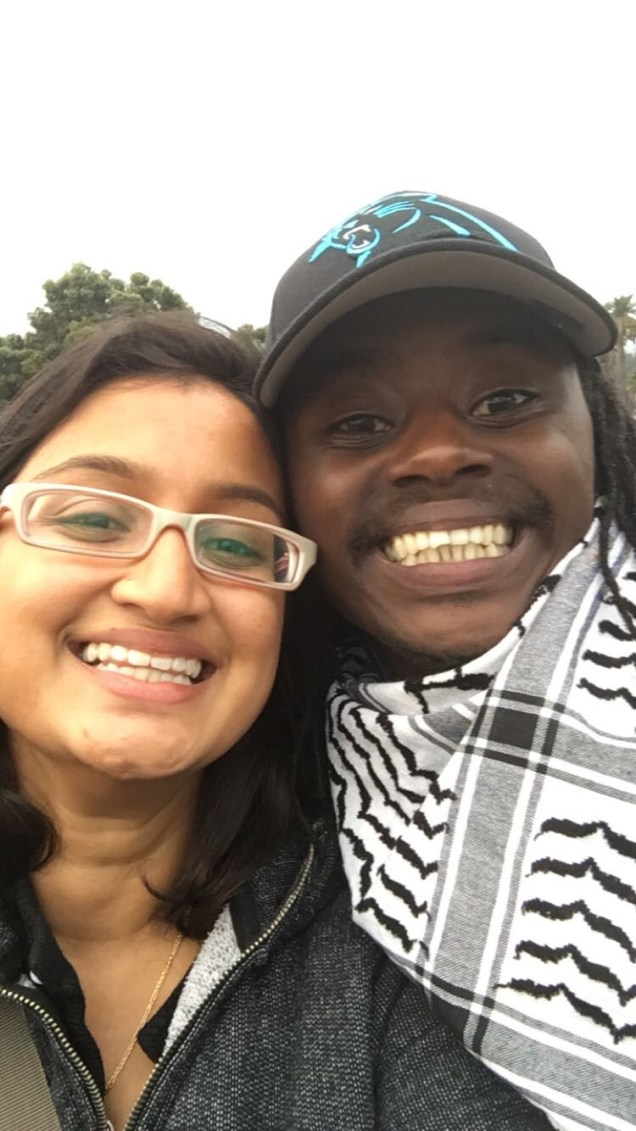
Aditi with Patrick K., one of the yoga teachers at AYP
“I became attracted to Purple Dot Yoga because of its mission to help empower women,” Desai said. “I love the fact that I can use something I love [yoga] to help others. Yoga is such a powerful tool in life and being able to spread it makes my soul shine!”
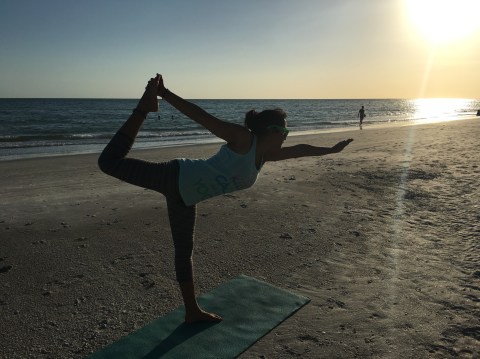
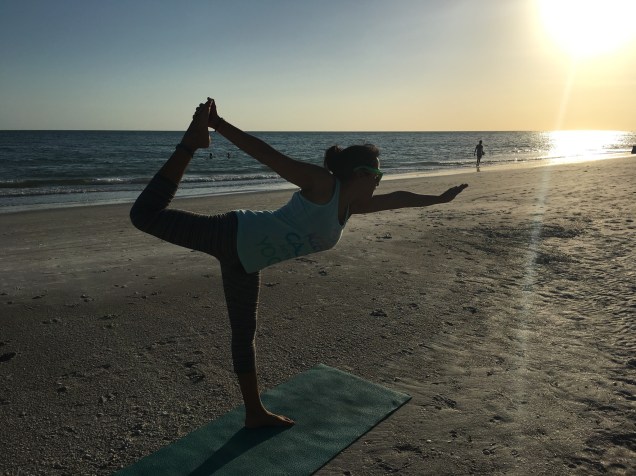
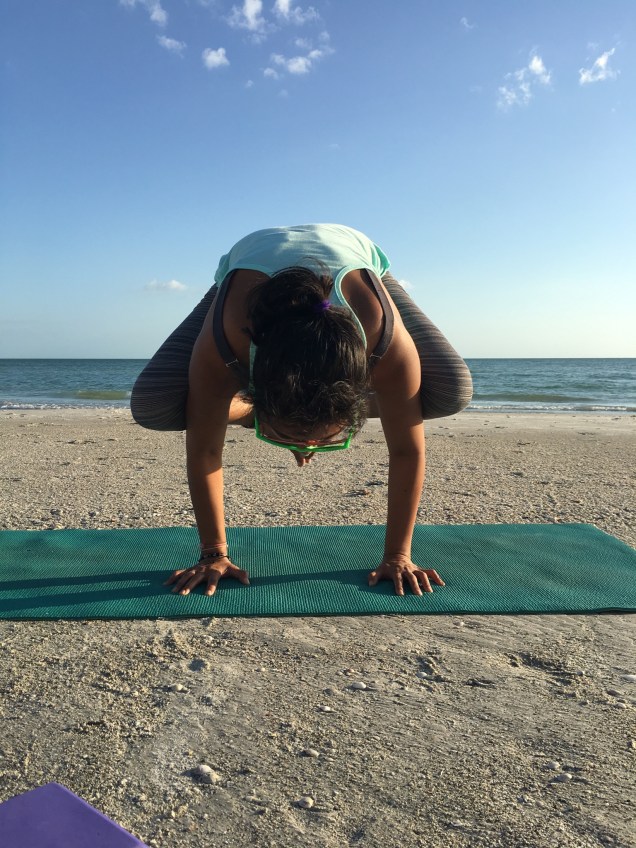
Aditi practicing yoga on the beach
The Purple Dot Yoga Project works with survivors of domestic violence and abuse.
Desai also works as a health education specialist with a medication assisted treatment program at Tri-City Health Centers in Fremont, Calif. In both of her positions, being able to effectively communicate is crucial.
“It is tremendously important that I not only listen, but really hear and try to empathize with the community that I’m serving,” she said. “I’m working with an extremely vulnerable population so listening to them and adjusting my teaching practices to better serve them and allow them time to heal is the most important thing I can do as a teacher.”
Desai credits the COPH for helping her to build the skills to be able to truly listen to the communities she’s trying to serve.
“USF COPH was the best thing that happened to me and my career,” Desai said.
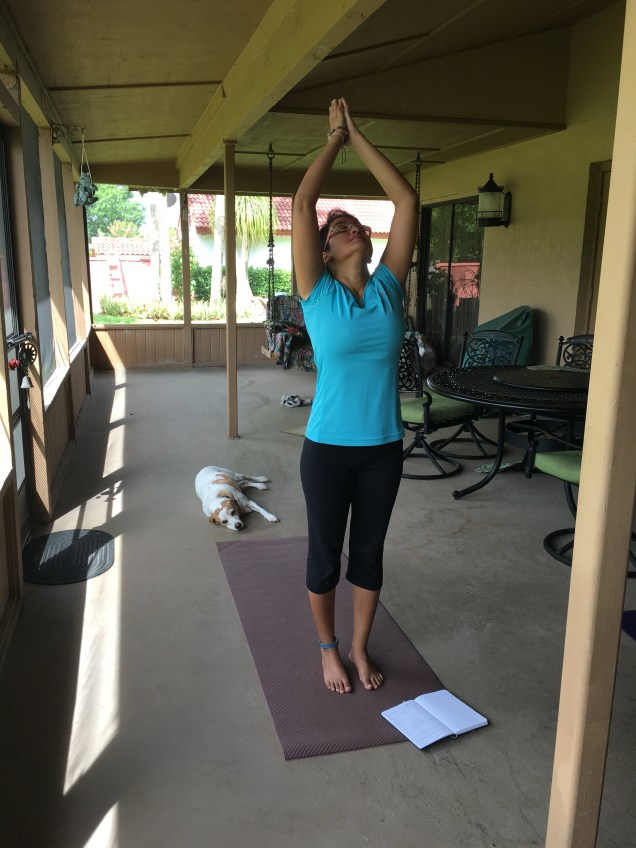
Aditi practicing yoga with her four-legged friend
The Orlando native earned her bachelor’s degree in psychology, with minors in biology, chemistry, and photography, from Mercer University in 2009.
She graduated from the COPH with an MPH in global health practice and a graduate certificate in epidemiology in 2013. Desai intended on a different academic path and often refers to her introduction to public health as “accidental.”
“I was planning on attending medical school and when I didn’t get in I thought instead of wasting time and retaking the MCATs, I would go ahead and get a master’s level degree while studying,” Desai said. “Little did I know, I would fall in love with the master’s degree coursework!”
Although she’s come so far—between Nairobi, multiple professional positions, working with the U.S. Peace Corps in Uganda—Desai has no intention of stopping anytime soon. The first thing on her list: the Purple Dot Yoga Project.
“I hope to expand the project to northern California,” she said. “I plan to continue acting as a volunteer yoga teacher.”
Desai also hopes to tackle a new vulnerable population using her yogi practices. Soon she begins teaching those in the medication assisted treatment programs at the Tri-City Health Center’s where she works.
“I am going to expand my yoga practices into teaching those in addiction recovery,” she said. “Using yoga to empower vulnerable populations is my ultimate goal and whatever I can do to achieve that, I will.”






/about/chaircatcow-56aa415e3df78cf772aed7a9.jpg)





.jpg)


 YogiDeets.com